Ayurvedic Treatment Hospital in Kerala, India, Ayurveda Resort, Doctor
THE BEST AYURVEDIC TREATMENT CENTRE AND HOSPITAL IN KERALA, INDIA | SINCE 1965

THE BEST AYURVEDIC TREATMENT CENTRE AND HOSPITAL IN KERALA, INDIA | SINCE 1965

How Is an Ayurveda Treatment Plan Personalized? 5 Vital Tips
Ayurveda traditionally takes an individualized approach to health rather than using exactly the same care plan for everyone. If you are wondering how is an Ayurveda treatment plan personalized, the process generally involves understanding your body constitution, current imbalance, digestion, lifestyle, diet, sleep, age, environment, and health concerns. In Thiruvananthapuram, people exploring traditional Ayurvedic care may encounter this personalized approach during an Ayurvedic consultation. The aim is to develop a plan that reflects the individual as a whole rather than focusing only on a single symptom.
Personalization is one of the central principles of traditional Ayurvedic practice. Two people experiencing similar discomfort may therefore receive different recommendations based on their individual assessment.
This guide explains how Ayurvedic treatment plans may be personalized, what factors are considered, and how diet, lifestyle, therapies, and daily routines can become part of an individualized approach.
1. What Does a Personalized Ayurveda Treatment Plan Mean
A personalized Ayurveda treatment plan is an individualized approach developed after considering a person’s physical characteristics, health concerns, daily habits, digestion, mental well-being, and other relevant factors.
Understanding how is an Ayurveda treatment plan personalized begins with an important Ayurvedic concept: each person has a particular constitution.
In traditional Ayurveda, this constitution is often understood through the three doshas:
- Vata – traditionally associated with movement and activity
- Pitta – traditionally associated with metabolism and transformation
- Kapha – traditionally associated with structure and stability
The proportions and characteristics of these doshas are considered different from one individual to another.
Therefore, Ayurvedic care is generally not based only on the name of a health condition. The individual’s overall condition is also taken into consideration.
2. Why Is Personalization Important in Ayurveda
Personalization is important because people can experience the same health concern differently.
For example, two individuals may both report digestive discomfort. However, one person might experience dryness, irregular appetite, and bloating, while another may experience a burning sensation and increased hunger.
From an Ayurvedic perspective, these differences may suggest different patterns of imbalance.
As a result, recommendations concerning food, daily routine, therapies, and other traditional practices may differ.
The personalized approach considers factors such as:
- Body constitution
- Current symptoms
- Digestive patterns
- Appetite
- Sleep
- Energy levels
- Daily routine
- Food habits
- Stress
- Age
- Seasonal influences
- Physical activity
- Existing health concerns
These factors help explain how is an Ayurveda treatment plan personalized for each individual.
3. How Is an Ayurveda Treatment Plan Personalized During Consultation
An Ayurvedic consultation generally begins with a detailed discussion about the individual’s health and lifestyle.
Rather than looking at a symptom in isolation, the practitioner may ask questions about several aspects of everyday life.
Understanding the Main Health Concern
The first step is usually identifying why the individual is seeking Ayurvedic care.
Questions may cover:
- When the concern started
- How frequently symptoms occur
- Factors that make symptoms better or worse
- Changes in appetite or digestion
- Sleep quality
- Energy levels
- Daily habits
- Previous or current treatment
This information helps create a broader picture of the person’s condition.
Reviewing Health History
Past health concerns can provide useful context.
The consultation may include discussion about previous illnesses, recurring symptoms, surgeries, current medications, allergies, and other relevant medical information.
People taking prescribed medicines should not stop or change them without guidance from the healthcare professional responsible for their treatment.
4. Understanding Prakriti or Individual Constitution
One of the key concepts involved in how is an Ayurveda treatment plan personalized is Prakriti.
Prakriti traditionally refers to an individual’s natural constitution.
Ayurveda commonly describes constitutional patterns according to Vata, Pitta, and Kapha. A person may have one dominant dosha or a combination of two or more.
Why Prakriti Matters
Understanding Prakriti may help guide traditional recommendations concerning:
- Food choices
- Daily routine
- Physical activity
- Sleep habits
- Massage practices
- Seasonal routines
- Lifestyle adjustments
For example, recommendations considered appropriate for a predominantly Vata constitution may differ from those traditionally suggested for a Pitta or Kapha constitution.
However, constitution is only one part of personalization. The person’s present condition must also be considered.
5. Identifying Vikriti or Current Imbalance
Another important Ayurvedic concept is Vikriti, which refers to the individual’s current state or imbalance.
Prakriti represents the person’s baseline constitution, while Vikriti describes changes that may be occurring at the present time.
These changes may be influenced by:
- Diet
- Lifestyle
- Sleep patterns
- Stress
- Climate
- Seasonal changes
- Physical activity
- Age
- Daily routine
Understanding the difference between Prakriti and Vikriti is important when discussing how is an Ayurveda treatment plan personalized.
A person may naturally have one constitutional pattern while currently showing characteristics traditionally associated with another dosha. The care plan may therefore focus more on the present imbalance while still considering the person’s natural constitution.
6. Evaluation of Digestive Function
Digestion has a significant role in traditional Ayurvedic assessment.
The concept of Agni is commonly used to describe digestive and metabolic capacity.
An Ayurvedic consultation may explore:
- Appetite
- Meal timing
- Bloating
- Bowel habits
- Food tolerance
- Feelings after eating
- Frequency of hunger
- Digestive discomfort
Why Digestion Influences Personalization
If two people have different digestive patterns, giving both exactly the same dietary recommendations may not fit the individualized Ayurvedic approach.
Food recommendations may therefore be adjusted according to appetite, digestion, constitution, current symptoms, and daily routine.
This is another practical example of how is an Ayurveda treatment plan personalized.
7. Assessment of Daily Lifestyle

Daily habits can significantly influence an Ayurvedic treatment plan.
The consultation may examine what time a person wakes up, when meals are eaten, work patterns, exercise habits, bedtime, screen use, and other routine activities.
Common Lifestyle Factors Considered
Important areas can include:
- Wake-up time
- Meal schedule
- Work routine
- Exercise
- Rest
- Sleep duration
- Travel
- Stress
- Screen exposure
- Hydration
Recommendations may then focus on creating a more consistent daily routine.
In Ayurveda, this approach is often connected with Dinacharya, or traditional daily routine.
8. Personalized Ayurvedic Diet Recommendations
Diet is another major component in understanding how is an Ayurveda treatment plan personalized.
Instead of following a single Ayurvedic diet suitable for everyone, food recommendations may vary according to individual needs.
Factors That May Influence Diet Advice
Recommendations can be influenced by:
- Dosha constitution
- Current imbalance
- Digestive capacity
- Appetite
- Age
- Season
- Food habits
- Health concerns
- Activity level
A plan may also consider meal timing, preparation methods, portion sizes, and how the individual responds to particular foods.
The objective is generally to create realistic dietary recommendations that can be incorporated into everyday life.
9. Selection of Ayurvedic Therapies
Ayurveda includes various traditional external and internal approaches. Their selection may depend on the individual’s assessment rather than simply choosing a therapy because it is popular.
Traditional Ayurvedic therapies may include practices involving herbal preparations, medicated oils, massage techniques, steam procedures, or other classical approaches.
The appropriate therapy, duration, frequency, and combination can vary considerably.
Panchakarma and Individual Assessment
Panchakarma refers to a group of classical Ayurvedic procedures. It should not be assumed that every individual seeking Ayurvedic care needs Panchakarma.
Suitability can depend on factors such as:
- Age
- Physical strength
- Constitution
- Current condition
- Digestive capacity
- Season
- Existing health concerns
Certain Ayurvedic procedures may not be appropriate for everyone and should be considered only after suitable professional assessment.
10. Role of Age and Physical Strength
Age is another factor that may influence how is an Ayurveda treatment plan personalized.
Children, younger adults, older adults, and people with reduced physical strength may have different requirements.
A person’s ability to tolerate particular therapies may also need to be considered.
The intensity and duration of traditional treatment may therefore be adjusted according to individual capacity.
This individualized approach is particularly important when considering more intensive Ayurvedic procedures.
11. Seasonal and Environmental Factors
Ayurvedic traditions also consider seasonal changes when developing lifestyle and dietary recommendations.
Temperature, humidity, rainfall, and other environmental conditions can influence everyday habits, appetite, activity, and comfort.
The Ayurvedic concept of Ritucharya refers to adjusting routines according to seasonal changes.
Depending on the season, recommendations may involve changes to:
- Food
- Exercise
- Sleep
- Daily routine
- Oil application
- Clothing
- Hydration
Therefore, an Ayurveda treatment plan may change over time instead of remaining identical throughout the year.
12. Mental and Emotional Well-Being
Ayurveda traditionally considers physical and mental well-being interconnected.
During an assessment, questions may therefore cover:
- Stress
- Emotional changes
- Work pressure
- Concentration
- Sleep
- Daily responsibilities
- Relaxation habits
These factors can influence recommendations concerning daily routine, rest, exercise, breathing practices, yoga, or meditation where appropriate.
Considering these areas provides another explanation for how is an Ayurveda treatment plan personalized beyond physical symptoms alone.
13. Symptoms That Influence the Treatment Plan
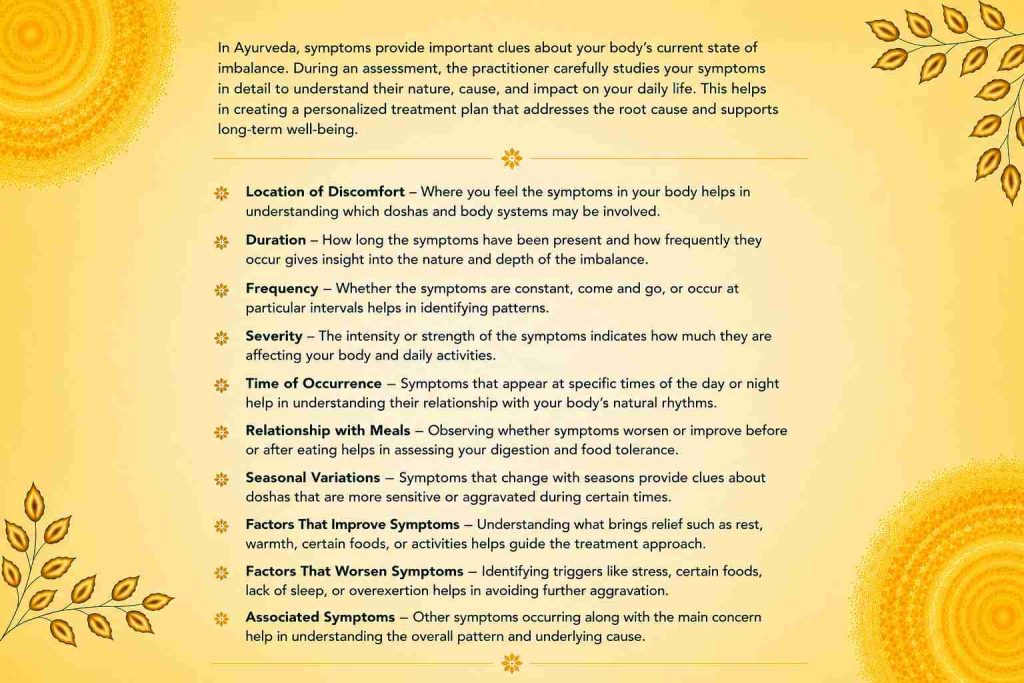
Symptoms provide important information during an Ayurvedic assessment.
However, personalization involves examining their characteristics rather than simply recording whether a symptom is present.
The practitioner may consider:
- Location of discomfort
- Duration
- Frequency
- Severity
- Time of occurrence
- Relationship with meals
- Seasonal changes
- Factors that improve symptoms
- Factors that worsen symptoms
Detailed symptom assessment can help differentiate between individuals who appear to have similar concerns.
14. Benefits of a Personalized Ayurvedic Approach
Understanding how is an Ayurveda treatment plan personalized also helps explain why individual assessment is emphasized in traditional Ayurveda.
Potential practical advantages of personalization include:
- Recommendations tailored to individual needs
- Greater attention to daily habits
- Consideration of diet and digestion
- Adjustments according to age and physical capacity
- Recognition of seasonal influences
- Ability to modify recommendations over time
- Consideration of both current concerns and constitution
Personalization can also make lifestyle recommendations more practical because they can be adapted to a person’s normal schedule rather than following a rigid universal routine.
15. How an Ayurveda Treatment Plan May Change Over Time
A personalized plan is not necessarily permanent.
As symptoms, digestion, sleep, appetite, activity, or other factors change, recommendations may also need adjustment.
Follow-up assessment can help evaluate:
- Changes in symptoms
- Digestive response
- Sleep quality
- Energy
- Appetite
- Bowel habits
- Response to therapies
- Ability to follow dietary advice
- Lifestyle improvements
The treatment approach may then be modified according to these observations.
This ongoing reassessment is an important part of how is an Ayurveda treatment plan personalized.
16. Tips for Following a Personalized Ayurveda Plan
An individualized plan is easier to follow when recommendations are practical and clearly understood.
Useful considerations include:
- Follow the recommended routine consistently.
- Ask why specific foods or habits have been suggested.
- Inform the practitioner about medications and existing medical conditions.
- Report unexpected symptoms or reactions.
- Avoid copying another person’s Ayurvedic plan.
- Do not assume every herbal preparation is appropriate for everyone.
- Keep track of changes in digestion, sleep, appetite, and symptoms.
- Attend follow-up assessments when recommended.
- Maintain realistic meal and sleep schedules.
- Seek appropriate conventional medical care when symptoms require medical investigation.
Ayurvedic care should complement appropriate medical evaluation rather than delay necessary diagnosis or emergency treatment.
17. Why the Same Ayurveda Plan May Not Suit Everyone
A common misunderstanding is that a particular Ayurvedic therapy, herbal preparation, or diet should produce the same response in everyone.
This does not reflect the individualized principles traditionally associated with Ayurveda.
Differences in constitution, age, digestive capacity, lifestyle, health history, physical strength, and current symptoms can all affect what may be considered appropriate.
This is why understanding how is an Ayurveda treatment plan personalized is important before comparing one person’s recommendations with another person’s plan.
Conclusion
Understanding how is an Ayurveda treatment plan personalized involves recognizing that traditional Ayurvedic care looks beyond a single symptom. Constitution, current imbalance, digestive capacity, diet, lifestyle, sleep, age, physical strength, environment, seasonal influences, and individual health concerns can all contribute to the plan.
The result is an approach in which dietary guidance, daily routines, traditional therapies, and lifestyle recommendations may differ from person to person and change over time. Anyone considering Ayurvedic care in Thiruvananthapuram should provide complete health information and ensure that significant or persistent symptoms receive appropriate medical evaluation. For reliable information about Ayurveda and its traditional practices, visit the National Center for Complementary and Integrative Health (NCCIH).
Frequently Asked Questions
How is an Ayurveda treatment plan personalized?
An Ayurveda treatment plan is traditionally personalized by considering factors such as body constitution, current imbalance, symptoms, digestion, diet, lifestyle, sleep, age, physical strength, season, and overall health history.
Does everyone receive the same Ayurvedic treatment?
No. Traditional Ayurveda emphasizes an individualized approach. People with similar health concerns may receive different dietary, lifestyle, and therapeutic recommendations based on their constitution and current condition.
What is Prakriti in Ayurveda?
Prakriti is the Ayurvedic concept of an individual's natural constitution. It is traditionally understood through different combinations of Vata, Pitta, and Kapha characteristics and is considered when personalizing Ayurvedic care.
What is Vikriti in Ayurveda?
Vikriti refers to a person's current state of imbalance according to Ayurvedic principles. It may be influenced by factors such as diet, lifestyle, stress, sleep, environment, and seasonal changes.
Why is digestion assessed before Ayurvedic treatment?
Digestion is an important part of traditional Ayurvedic assessment. Appetite, bowel habits, food tolerance, bloating, and other digestive characteristics may be considered when developing personalized dietary and lifestyle recommendations.
Is an Ayurvedic diet the same for everyone?
No. Ayurvedic dietary recommendations may vary according to an individual's constitution, digestive capacity, current symptoms, age, season, food habits, lifestyle, and overall health needs.
Can an Ayurveda treatment plan change over time?
Yes. An Ayurveda treatment plan may be adjusted as symptoms, digestion, appetite, sleep, energy levels, lifestyle, or other health factors change. Follow-up assessments can help determine whether modifications are appropriate.
Does every personalized Ayurveda plan include Panchakarma?
No. Panchakarma is not automatically required or suitable for everyone. Its suitability depends on individual factors such as age, physical strength, constitution, current condition, digestive capacity, and overall health.
Are lifestyle changes part of personalized Ayurvedic treatment?
Yes. Daily routines, meal timing, sleep habits, physical activity, stress management, and other lifestyle factors may form an important part of a personalized Ayurvedic treatment plan.
Why are follow-up consultations important in personalized Ayurveda?
Follow-up consultations help assess changes in symptoms, digestion, appetite, sleep, energy, and overall well-being. Based on these observations, dietary, lifestyle, or therapeutic recommendations may be adjusted when necessary.
Call Now
+91 7356 445 553
+91 8921 442 253
We Welcome You
Vandithadam, Pachaloor P.O,
Thiruvananthapuram,
kovalam, kerala India
Sent Email
info@sivasoorya.org





Connect with Kerala’s Leading Ayurveda Centre for treatment enquiries, Panchakarma scheduling, wellness retreat packages, or customised Ayurvedic guidance. Our skilled Ayurvedic specialists and support team assist guests from India and abroad with trusted insights, professional care, and well-defined recommendations for lasting healing.
Quick Link
Services

